Well here we go again!
Despite everything-- American democracy unraveling at its seams,
wildfire in California and other environmental disasters, North Korea going
nuclear and most likely creating untold havoc to the peace in East Asia, sad
passings of friends, admirable people and great artists, some of whom were tragically
young--, and despite the killing academic schedule and deadlines, I am back
here at January 13, to upload My Favorite Blu Rays of 2017. As usual, I have already completed and
uploaded the Korean-language version of it, which, also as usual has a slightly
different titles for its lower ranks from this one.
This year, the proportion of DVDs among the discs I
have procured has for the first time declined below 20 percent. A notable development, as DVDs are still
churned out with regularity by most studios: none of them has given up on it in
favor of Blu Ray. Even Netflix still stocks a large chunk of its (now
admittedly half-hearted) video rental items (ah, yes, don't be surprised. They still rent out the DVDs and Blu Ray
rentals like the good ol' days) as DVDs rather than Blu Rays. Yet, in 2017 it
became glaringly obvious that even stockpiling a good portion of desirable Blu
Rays released in a single year would be more than I could handle, financially
and living-space-wise (help!).
Indeed, contrary to the world and American politics
that seems to be plunging down the rabbit hole (although, to be fair, there
have been some good signs: victories of liberal candidates in close state
elections despite active gerrymandering by the Republican establishment, Me Too
movement spurred by outrageous revelations of the misconducts by Hollywood's powerful
men, and so on), the Blu Ray collector had another banner year, now tinged with
perhaps a slight sense of awe, to be perfectly frank.

In 2017, the center of my BD purchase market displayed
signs of a subtle migration from the US to the United Kingdom. Whatever idiocy
generated from the Brexit campaign we might have to deal with in this year, the
British labels really elbowed aside their brethren across the Atlantic to
declare themselves. Who could have
expected, to cite just a few examples, that Arrow Video, long a specialist in
the cult genre titles, would not only successfully branch off to the stateside,
but also release the nine-disc (!) Jacques Rivette collection, and the British
Film Institute would come up with a beautiful Blu Ray of Rivette's Celine and Julie Go Boating? Studio Canal and Network continue to make
available a slew of classic Anglophone titles on Blu-- films of Cy Endfield,
Joseph Losey, Val Guest, classic SF and films noirs, to number a few. Eureka! (mostly through its Masters of Cinema
imprint) has extended its reach to more recent Asian films missed out by their
American competitors, such as Kawase Naomi's Mourning Forest and Kurosawa Kiyoshi's Creepy and Journey to the
Shore. It is icing on the cake that
a large proportion of these discs are Region Free, but if any year gave a
serious collector of world classical cinema sufficient reasons to immediately
purchase a Region Free Blu Ray player (or, for that matter, an extra Region B
player), it was 2017.
Hold on, but does this mean that they are moving away
from the red-carpet treatment accorded to Mario Bava, Dario Argento, the '70s Italian
gialli, Hammer and Amicus horrors and
other genre home video staples? You
gotta be kidding, right? Arrow is still leading the fray in lavishing the care
and attention of a Vatican church-fresco restoration specialist to these
titles. Frankly, I am compelled to
wonder if a label like Powerhouse Indicator, now graduating from releasing the
spit-and-sparkle Blu Ray editions of such usual suspects as Brian De Palma and
John Carpenter to lesser-known but historically and aesthetically significant
'70s and '80s titles such as Hardcore,
Blue Collar and The Last Detail, is operating under a profit motive at all. We can add to all this the beyond-the-call-of-duty care these labels put into designing amazing new covers, totally in the
spirit of the original films, and jam-packing each title with educational
supplements.
In 2017, it was even tougher to whittle down the list
to 25 than it was to 20 in 2016. It
became slap-in-the-forehead evident around early December last year that there
was no way that the list could be
confined to just twenty items. At one
point I have contemplated shutting down the sluice at number thirty, but that
just begged the question of why not at 35, or 40, and so on. So, here we are, twenty-five of my favorite
Blu Rays of 2017.
As usual, a disclaimer: the following list is not a list
of "best" movies represented in BD last year, however you might
define "best." Neither does it represent technically the most
impressive restorations, rescue jobs and/or transfers. The included items have
only one thing in common: they were astonishing titles that gave me the
pleasure and shock of discovery and re-discovery or otherwise punched me in the
gut, making me realize that the world of cinema has no boundaries except those defined
by your imagination. The reasons for their inclusion are intensely personal,
and I let my emotional responses-- a wallop in my stomach, tears flowing from
my eyes, barks of disbelieving laughter inadvertently escaping from my throat--
rather than intellectual calibrations serve as my ultimate judge. I have a zero problem admitting that Stanley
Kubrick's Barry Lyndon and
Tarkovsky's Stalker are
world-classics and their availability via Criterion on Blu Ray is seriously
gratifying: they are nonetheless not included in my list. Not to worry, these
and other renowned titles are plenty popular in other year-end lists! (Check
out Cine Savant's list, 100 aggregate best-of-the-year titles from DVDBeaver,
and Mondo Digital's 30 significant titles)
As before, one package,
regardless of the actual number of discs, is treated as one title. Needless to say, all selections had to be
released within the year 2017 to qualify.
25. Fright Night
(1985, Eureka! Region All)
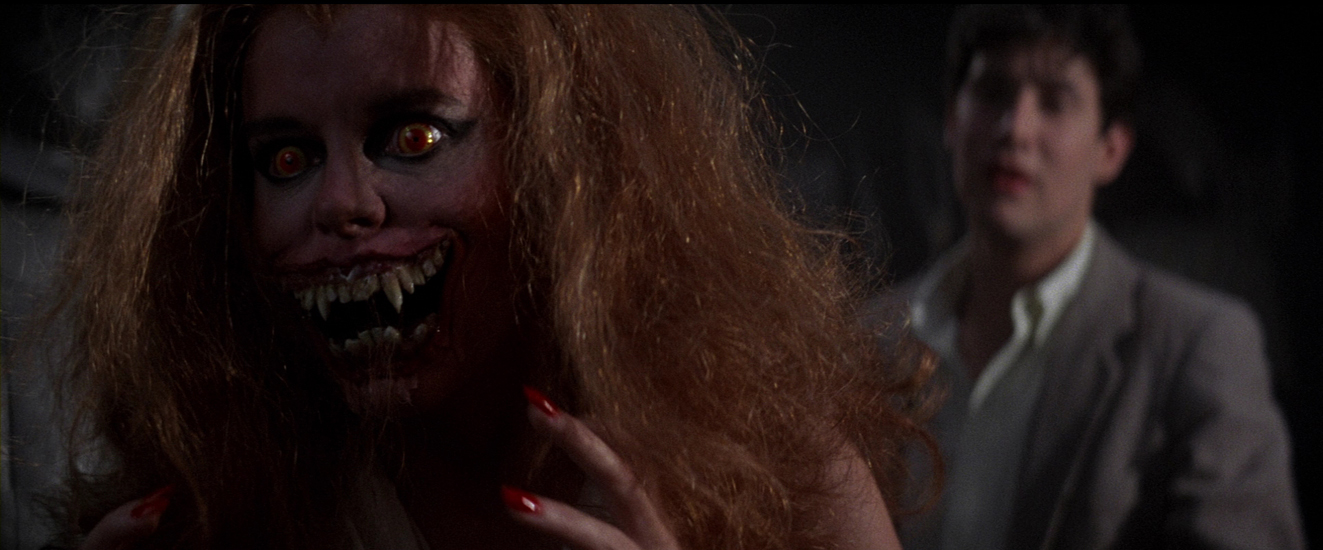
Talk about surprise!
I did not expect Eureka! of all labels to issue the special edition of
this '80s favorite, transferred in 4K with positively jaw-dropping gradations
in black levels as well as insane sharpness and packed to the gills with
supplements, including a delightful footage of the 2008 reunion of director Tom
Holland and the main cast and its piece
de resistance, a 146 minute (!)-long making-of documentary, You're So Cool, Brewster. The edition practically oozes with fan
enthusiasm and sheer love for this clever vampire flick, surprisingly
sophisticated and witty, epitomized by tongue-in-cheek yet never condescending
performances of Chris Sarandon (as the lead vampire) and the late Roddy
McDowall (as a Vincent Price-like old horror film star Peter Vincent). A thoroughly delightful release.
24. Rat Fink
(1965, Retromedia, Region All)

This is the title that bubbled up to the surface from
the Incredible Movies That I Have Not Even Heard of Until I Saw Them category. Rat Fink is apparently a follow-up
effort of the team that had produced The
Sadist (DVD collectors might remember it as one of the earliest special
edition DVDs ever from a non-studio
label, in this case David Kalat's All Day), headed by director James Landis and
cinematographer Vilmos Zsigmond. The latter of course graduated to a
spectacular Hollywood career, working with Robert Altman and Steven Spielberg
in '70s and beyond, and is still the most recognizable name attached to this
curio. Produced to showcase its lead
actor Schuyler Hayden, Rat Fink was
actually released to the theaters and even received some good critical
notices. But then, Hayden, disappointed
that the film had failed to give him a star-making "big break,"
packed luggage and relocated to Hawaii along with his family. He was persuaded
to reignite his career in '70s again, only to tragically pass on due to a freak
airplane crash in California. The film's negative was subsequently destroyed in
a fire. It appeared that Rat Fink was
one of those lost films that show up as "entries" in a career resume
but have been seen by few other than the folks involved in actually making
it.
But then again, a well-preserved 35mm release print
was somehow located, and Retromedia jumped in to scan it for Blu Ray. Is Rat Fink any good? I don't think it is a rediscovery of a lost
masterpiece (to their credit Retromedia does not try to oversell the film's
historical value), but nonetheless it makes for a compelling viewing. Like The
Sadist, there is something deeply disturbing about the film's
matter-of-fact depiction of awful violence-- physical, sexual and of course,
emotional-- despite its relative lack of explicitness (there is no real nudity,
for instance), and Hayden, not un-charismatic and looking like a cross between
Jack Nicholson and Warren Beatty, gives a maybe technically unrefined but riveting
performance. He seems genuinely angry at the world, but is also highly
convincing playing a sociopath who pathetically grovels at the feet of his
manager once the goings get really tough.
It is enough for us to wonder what might have happened had Hayden
managed to construct a solid foundation for a Hollywood career in late '60s. The film, viciously cynical yet also suffused
with what I think is a genuine sense of melancholy, fits in well with the other
early '60s indie efforts such as the works of Monte Hellman, Jack Hill and
Roger Corman (think of his subversiveThe
Intruder).
23. Parents (1988, Lionsgate, Region A)

One of the news that brought joy to the hearts of the
fans of '80s horror, SF and fantasy cinema was Lionsgate's acquisition of the
titles released through the old VHS company, Vestron. They even named it
Vestron Video Collector's Series. Along
with the more familiar titles such as the Warlock
trilogy (the first one with Richard E. Grant and Julian Sands is an underrated
gem, the rest, ur, serviceable), the Wishmaster
films (I am a big fan of Andrew Divoff. Somebody give him a meaty role, where
he actually gets to use his multilingual talent! The movies themselves… ah
well), Waxwork and its sequel, Chopping Mall and Blood Diner, the series contains some surprising entries, including
a charming SFX showcase The Gate, Ken
Russell's Gothic and Lair of the White Worm, and this
remarkable meditation on the hypocritical underside of the early postwar
suburban America, a la David Lynch's Blue
Velvet. Directed by the noted
character actor Bob Balaban from a screenplay by Christopher Hawthorne,
apparently a specialist in children's TV, Parents
had left me an indelible impression in its combination of boldly surrealistic
touches-- sometimes going overboard, as in a memorable scene in which the
protagonist boy is drowned in a pool of blood that suddenly surge out of his
bed-- and compellingly observed, almost repellent details of an American
suburban life.
The Blu Ray comes with Balaban and producer Bonnie
Palef's audio commentary and other key cast and crew interviews: a wonderful
nostalgic trip to the hair-raising heydays of '80s American genre cinema
hybrids.
22. The House That Screamed/ La Residencia (1970,
Scream Factory, Region A)

21. The Man Between (1953, BFI/Studio Canal, Region B)

The British Film Institute has been restoring major
and minor classics of British cinema and releasing them on Blu Ray via Studio
Canal, whose copyright library seems to be truly vast, and following their
release of the impeccably produced The
Fallen Idol (reviewed in this blog) is this lesser-known Carol Reed film. The Man Between has not been as well
received as The Third Man, also set in
the postwar Berlin, reviewers and critics no doubt pointing to the absence of
Graham Greene's screenplay and its somewhat clichéd Cold War plot machinations
as reasons for its weakness. However, I
found the film powerful and riveting, peppered with the time-capsule moments of
the early '50s Berlin, marked by grotesque, gargantuan rubbles of the bombed
buildings that look like a dystopian alien landscape covered in white
snow. James Mason is the star, an
archetypal "Divided Nation" character, and as usual charismatic, if
somewhat iffy with the German accent, but the movie's true guiding presence is
a young British schoolteacher visiting her military brother played by Claire
Bloom, practically debuting with this film.
Bloom is positively radiant as another in the series of Reed's female
characters who are beautiful, spiritual but also not afraid to take charge,
even in the matters of life and death.
Considering how enchanting her presence is in this
film, it is somewhat distressing to hear her talk about Reed's less than
gentlemanly behavior towards her (according to her recollection) in her
brand-new interview. The Blu Ray also includes a long-form documentary Carol Reed: A Gentle Eye that makes an
excellent case for reevaluating the significance of this filmmaker in charting
the evolution of the interwar and immediate postwar Anglophone cinema.
20. Suddenly in the Dark 깊은 밤 갑자기 (1981,
Mondo Macabro, Region All)

We Korean fans of classic genre cinema, plus fans of
Korean classic genre cinema (Oh well, I am realistic: even if we combine these
two constituencies, I know their numbers may not be large enough to fill the
parking lots of a local Walmart store) collectively turned our heads, when Mondo Macabro, the leading purveyor of
the global bizarre cinema, whose reach is seriously
international, from Ukraine and Greece to Indonesia and the Philippines,
announced that they will be bringing one of the local cult favorites, Suddenly in the Dark, to Blu Ray.
Scanned from the best surviving elements stored
in the Korean Film Archive, the long-vilified film, a staple in the VHS market
and late-night TV screenings during which it permanently warped the minds of
many pimply teenagers, now twists and turns like a dervish under the
eye-popping multi-colored Bava-esque lighting, ready to sear itself into the
brain tissues of many non-Korean genre aficionados! A truly bizarre
film for which that adjective is not a hyperbole, it belongs to any adventurerous classic horror fan's shelf. Kudos to Mondo
Macabro for making this release into a reality: can I dream about them one day releasing to BD seriously obscure Korean genre titles such as Insayeomu
(1975), a Korean-Filipino taekwondo-action-snake-woman's
curse-horror-softcore-erotica mash-up?
19. The New Centurions (1972, Powerhouse Indicator,
Region All)

The British label Indicator's big surprise BD release
of 2017 was this Joseph Wambaugh adaptation, an important Merkmal in the evolution of one of America's most prolific
cinematic and TV genres, "realistic" cop shows that attempt to
capture the moral and political complexities of the police work. Richard Fleischer, who, based on the sheer
number of great BD titles directed by him in recent years, is due for a major
re-evaluation as one of the masters of '60s and '70s American cinema, directs
from Stirling Silliphant's screenplay, but the movie's core strengths lie in
the lead performances of Stacy Keach (who delightfully shows up in a cast
interview, thoughtful and judicious as ever), George C. Scott, Jane Alexander
as well as of a host of actors in supporting roles (including a surprisingly
effective pre-CHIPS Erik Estrada).
18. Hammer House of Horror: The Complete Series (1980,
iTV Studios/Network, Region B)

Network, which has become one of my favorite labels
since 2015, is now remastering the key genre TV series in their catalogue into
Blu Rays. Classic TV in Blu Ray is a
mind-bending conundrum for an anti-revisionist like myself, as HD transfers
of the 35mm film materials for certain TV shows allow us, in the 21st century, to watch
them in the kind of quality never actually seen by the contemporary, intended
viewers. No matter how excellent one's broadcast service and hardware might
have been, it still could not have appeared as sharp and detailed as their HD
remastered incarnations look to us, Blu Ray collectors, today. So far
Space 1999 (which I have always
preferred to Star Trek-- granted, the
writing in the former show was sometimes less than stellar, but I've always
found Star Trek talky and
overbearingly American, to be honest), The
Prisoner (a cult TV series if there ever was one), Quatermass, The Persuaders
and UFO (the latter two almost
gluttonous in terms of the supplementary information Network managed into jam
into the multidisc collector's boxes) have been released, but my choice for
2017's Network Blu Ray is this scrappy, short-lived (just thirteen episodes,
which in a sense is a perfect number) TV series from Hammer Studios in its twilight days (of the classic period, I should add).
Considered grungy and perhaps predictably exploitative at the time of its debut, the Hammer
House of Horrors enjoys an improved reputation today, as the youngsters
exposed to the show in syndication (it certainly played in Korea via AFKN,
almost completely uncensored, too, with most of the nudity and violence intact)
have matured and come to appreciate its unbridled commitment to the red-meat
horror content. Indeed, some episodes of
the series-- including "Rude Awakening," featuring the great Denholm
Elliott, "Guardian of the Abyss," a terrific demonic possession tale
presented in the boxset in an alternative version masked at 1.78:1 theatrical
ratio (it looks fabulous!) and "The Silent Scream" starring Peter
Cushing and young Brian Cox in top form-- handily beat the studio's later-phase theatrical
films in terms of their sheer quality of acting, direction and atmosphere.
17. OSS 117 Five Film Collection
(1963-1968, Kino Lorber, Region A)

As this list would presumably make it abundantly
clear, 2017 was the year that Kino Lorber went berserk with the kind of
completely unexpected titles more appropriate for a European label. I had heard of OSS 117 films, a series of spy
adventure novels adapted into the movies starring an American agent with the
amazing name of Hubert Bonisseur de la Bath (!). My memory of these films is generally
associated with the dismissive reviews blocking them into a jumble with
countless other rip-offs of the James Bond franchise. It turns out that neither the novels by Jean
Bruce (continued on by his wife Josette Bruce and eventually by their children
into 1990s) nor the movie adaptations are really pastiches of the more famous
British secret service agent and his exploits: they are, for one, extremely French, a quality that would have been
lost to an extent if watched in English dubbing, and in the versions edited by
American importers to emphasize action sequences.
These five films, starring Kerwin Matthews (yes,
Sinbad himself!), Frederick Stafford (later cast in Hitchcock's Topaz) and John Gavin (considered for
the role of James Bond in Diamonds Are
Forever) all come with the original French language soundtracks. In many ways dated, yet also beautifully
photographed, surprisingly effective (as in Matthew's terrific karate bout with an assassin in his
hotel room, for instance) and full of unexpected fun for European genre film
fans (none other than George Eastman shows up as the uproariously fey
supervillain Curt Jurgens's premier henchman in OSS 117: Double Agent!), I
am very glad I decided not to pass by this title on the account of its rather hideous cover design (ur, this is one area for which Kino could secure some
extra budget…).
16. Drunken Master 醉拳 (1978,
Eureka! Masters of Cinema, Region All)

As I pointed out above, I really appreciate Eureka!'s
conscious inclusion of post-'60s Asian films in their repertoire, but even
considering that this was a pleasant surprise.
I know there is a possibly unbridgeable perception gap between a North
American and an East Asian filmgoer
grown up in '70s and '80s regarding the stardom of Jackie Chan. I don’t
think anyone who was not there in Hong Kong, Taiwan, Korea, Japan or Singapore
could really appreciate just how big Chan was… and has consistently been so, throughout
the last four decades.
I recently read a review of The Foreigner, whose author seems to characterize Jackie as an aging martial arts star who had failed to break it into the Anglophone
mainstream: someone with the comparable cinematic stature of, say, Jean Claude
Van Damme. Bless the Belgian's heart,
but seriously, guy, Chan is not Van
Damme. He is the biggest movie star on this side of the globe, and again, has been
so for 40 years. Someone with the
stature of Clint Eastwood might be an acceptable comparison, maybe, but Jackie
as a "local" Oriental star struggling to gain acceptance of the North
American public? A positively insulting
characterization, not to mention vastly ignorant about the reality of the
world: from such depths of ignorance erupt the dark forces of a Trump
presidency and the Brexit campaign… sigh.
The Masters of Cinema presentation does full justice
to this ultra-low-budget, borderline-primitive yet historically momentous
martial arts comedy, restoring its theatrical Cantonese soundtrack allegedly
not heard since its 1978 debut, equipping it with multiple English-language
subtitles (a la Criterion's ploy with Kurosawa) and a slew of commentaries and
essays by the likes of Tony Rayns, Jeff Yang and the film director Gareth
Evans.
15. Liquid Sky
(1982, Vinegar Syndrome, Region All)

One of the oddest cult films to emerge from '80s,
which is truly saying somethin', Liquid
Sky is a fluorescent, narcotics-induced pleasure dream/nightmare that also
has a strangely endearing quality to it, starting with the premise of extraterrestrial(s)
ensconced in a dinner-plate sized flying saucer acting as the plot's catalytic agent.
I don't know whether you could call Anne Carlisle's performance "good,"
but she is certainly unforgettable in the dual role as a heroine-addicted poser
Jimmy and an emotionally needy androgynous model Margaret. And no doubt some of
you wish you could forget-- and cannot-- Paula E. Sheppard's (also in the cult
film Alice, Sweet Alice: where is she
now?), ur, oral performance of "Me and My Rhythm Box."
A brainchild of Russian émigré director Slava
Tsukerman and a perfect film to acid-dissolve your cinephile friend's lofty idea
of what an "arthouse" motion picture is supposed to be, Vinegar
Syndrome presents the film, some portions of which bear the imprint of
guerrilla filmmaking and less-than-optimal conditions for special effects work,
in a 4K HD scan from camera negatives, complete with piles and piles of special
features, some of which also look appropriately, hmm, grungy.
And yes, I saw Liquid
Sky in a movie theater. So now you know why I am like this.
14. The Day of the Jackal (1973, Arrow Video, Region
B)

I fully understand the criticisms labeled at High Noon for its political stance, but
I still think it is one of the greatest Westerns I have seen. Perhaps it speaks to me because of my own
outlook in life, who knows. Fred
Zinnemann, whatever his ideological proclivities might have been, cannot be
questioned about his mastery of filmmaking craft. His later films in particular
have the cutting precision of an unsmiling genius chess player. The Day of the Jackal is a taut
political thriller with a total concentration on the procedure-- Jackal,
portrayed with suave steeliness by Edward Fox, is matched by the dedicated
civil servant Deputy Commissioner Lebel (Moonraker's
Michel Lonsdale)-- that effortlessly paints circles around most of the
contemporary thrillers depicting similar situations (Bourne films, the Mission Impossible series, with Tom
Cruise always mugging the camera with his "earnest" looks, and so
on).
The only thing in the movie that strikes me as awkward
is the way in which Jackal dispatches human obstacles to his project with his
bare hands: at one point he strangles a person, and the poor victim simply
drops dead in about thirty seconds. Oh
well, nobody's perfect.
13. The Last Witness 최후의 증인 (1980, Korean Film Archive/Blue Kino, Region All)

Along with A
Little Ball Launched by a Dwarf, this director Lee Doo-yong's magnum opus is one of the Korean films from
which we can palpably feel the underground energy of the oppressed peoples, who had just about had enough, about to erupt and topple the military dictatorships of '70s and early '80s. Based on
a popular mystery novel by Kim Seong-jong, Lee's feature is an epic meditation,
under the guise of an ostensibly anti-Communist crime procedural, on the
sufferings visited on the good and the decent by the cruelties of modern Korean
history. Korean Film Archive about a decade ago restored this film to its
uncensored length of two hours and 34 minutes, leaving those lucky enough to
catch it during revival screenings reeling from shock.
In 2017, the agency issued it as a special edition Blu
Ray, meticulously reconstructed with each frame cleaned and color-timed to the
specifications of the director and cinematographer Jeong Seong-il, one of the
masters of classic Korean cinema, complete with enthusiastic and admiring
commentaries by such notables such as The
Handmaidens director Park Chan-wook and critic Kim Young-jin.
12. The Sea Wolf (1941, Warner Archive Collection,
Region A)

Talking about restorations of lost classics, of
course, we must not forget Warner Archive Collection, by now seemingly
committed to releasing three or more Blu Ray titles per month. The last year's
astonishing BD title from WAC was this cinematic adaptation of Jack London's
novel, reconstructed to its original 1941 premier length of 100 minutes
(previously, the 86 minute-long re-release print cut in 1947 has been the only
available one) from original 35mm nitrate elements. With Edward G. Robinson at his most
incredibly diabolic, John Garfield, Ida Lupino and Alexander Knox as the
intellectual narrator-scribe, The Sea
Wolf is an overwhelmingly intense seafaring adventure cum film noir. Robinson's Captain Wolf Larsen is a
frighteningly crafty, cannily evil dictator of the pirate ship The Ghost, and yet the viewers are
unable to unconditionally condemn him-- he is much too a familiar figure, not
really the exotic and distant Enemy but, in truth, One of Us.
A stunning artistic achievement by the sometimes
underappreciated director Michael Curtiz, The
Sea Wolf leads the fray in the bountiful WAC releases of 2017 including
other classical titles such as Hell on
Frisco Bay, Seven Days in May, Wait until Dark, Bad Day at Black Rock and Ride
the High Country, among others.
11. Funeral Parade of Roses 薔薇の葬列 (1969, Cinelicious Pics, Region A)

In 2016, Cinelicious Pics flabbergasted fans of
classic Japanese animation with their astonishing reconstruction and release of
Tezuka Osamu production's Belladonna of
Sadness. In the last year, they reached out to one of the quintessential
signposts in the international queer cinema, Funeral Parade of Roses, a daringly avant-garde yet surprisingly
emotional take on Oedipus Rex,
interspersed with the interview segments of the young "gay
boys." The fans of Japanese SF
cinema and Kurosawa Akira might be stunned to recognize the very familiar face
of Tsuchiya Yoshio, the Human Vapor
himself and a veteran of numerous Toho Godzilla films, in a steamy love scene
with the transgender actor-singer-TV personality Peter, who memorably played
Kyoami, the court jester character in Kurosawa's Ran (inexplicably looking at least a decade younger in the latter
film, released in 1985!).
In addition to the impeccably HD-transferred main feature (previously only available via SD bare-bones edition via Masters of Cinema series), this Blu Ray edition collects eight short films of director Matsumoto Toshio as supplements, providing an amazing glimpse into the '60s experimental cinema that attempted to consciously break down boundaries between fictional and documentary films.
10. Deluge (1933, Kino Lorber, Region A)

A pre-code apocalyptic disaster film, Deluge is primarily known for its
climactic destruction of New York City by the huge tsunami generated by the drastic climate change (whoa, something guaranteed not to happen in real life! Fake news!), which is darn
impressive in its own light, but the film is giddily entertaining as well as thought-provoking in other
ways. It is brutally honest in its
appraisal of the deterioration of the American society (circa 1930s) at the
face of large-scale economic disaster (especially in graphic depictions of women's vulenrability) and features a genuinely attractive heroine in
Peggy Shannon, who falls in love with a upstanding survivor unaware that his
wife and child had also survived the disaster and is willing to start a new
life with her.
Tough-minded but never cynical, Deluge is another pre-Production Code American classic that, when seen in a great presentation, fully measures up to its unrealistic-sounding reputation.
Tough-minded but never cynical, Deluge is another pre-Production Code American classic that, when seen in a great presentation, fully measures up to its unrealistic-sounding reputation.
9. Othello (1952/1955, Criterion Collection, Region A)

Criterion's painstaking reconstruction of Orson
Welles's Shakespearian adaptations hit its zenith with the 2016 release of Chimes at Midnight. Here we have a slightly more problematic
case, a flagrantly cinematic Othello
fraught with production difficulties (continuous short-changing of the budget,
which led to some amazingly creative touches such as setting a key dramatic
scene in the Turkish bath, where characters jaunt about clad only in towels:
Welles was unhappy with the leading lady Suzanne Cloutier, whose voice ended up
being dubbed in the 1955 version: and so on) and almost flaunting its dancing-at-the-edge-of-the-sword filmmaking hutzpah. It leaves little doubt as to Welle's mastery
of cinema as an aesthetic medium, but his interpretation of Othello as an actor
is strangely passive, almost rigid, as if he had abandoned any effort to resist
the fate's cruel scenario. In the insert essay,
Geoffrey O'Brien makes the case that his performance is a meta-cinematic
reflection on his own precarious and doubt-wracked position as the creator of
this project: well, maybe. Or
perhaps Welles was genuinely uncertain about how to play this role: a powerful
foreigner admired, feared and respected yet never truly accepted as one of
their own by the "Europeans" he is called upon to protect and
serve.
In any case, Criterion's rehabilitation of Orson
Welle's films on the home video-- Mr.
Arkadin, F for Fake, Chimes at Midnight, The Immortal Story, and now Othello--
has to count as one of the most amazing feats of cinematic reevaluation in
recent years. This is indeed a title that reminds us why Criterion Collection
remains Criterion Collection in the eyes of its devotees…
8. Caltiki The Immortal Monster/Caltiki il monstro
immortale (1959, Arrow Video, Region A)

…yet, I wouldn't be surprised if Arrow Video surpasses
Criterion Collection in a few years, in its care and passion in shepherding the
classic titles either of academic importance or cult
reputation. We would have been glad that
a title like Caltiki il monstro immortale,
a minor Italian horror film ripping off the ingenuous premise of The Blob, a cheapskate but effective
monster in the form of a jelly-like amorphous, amoebic creature that simply
absorbs and dissolves its prey, was merely made available in a watchable form with readable English subtitles. Only two decades ago, a film like this would have merited little more than a curious footnote in the
career overview of Mario Bava, responsible for Calitiki's special effects design and
wrangling as well as much of its direction.
Today, you can trust Arrow Video to not only locate
the intact elements and provide a unrealistically sparkling 2K scan of them but
also to jam-pack their release with practically endless supplementary
materials, beginning with two separate audio commentaries by Tim Lucas and Troy
Howarth and an alternative, 1.33:1 full-frame presentation of the film, solely intended to
have the widest coverage of the Bava-directed special effects.
7. Suspiria 40th Anniversary 4K Restoration Edition
(1977, Synapse Films, Region A)

Oh what can I do? I have stated elsewhere that the
biggest beneficiary among the filmmakers of the optic media disc revolution has
not been Jean-Luc Godard, not Bernardo Bertolucci, not Stanley Kubrick, but
Dario Argento. And here is yet another
proof of that statement.
Suspiria is not even my favorite horror film, but as a collector of classic cinema on physical media, I do not know how I could have avoided honoring this 4k restoration special edition, under the supervision of Don May, head of Synpase Films, that had allegedly taken more than three years of painstaking cleansing and recalibration frame by frame. The result is perhaps even more stunning in terms of sound than the famously candy-colored visuals, especially in the new DTS-HD mastered English soundtrack, supposedly never heard outside the theatrical premier in 1977.
Suspiria is not even my favorite horror film, but as a collector of classic cinema on physical media, I do not know how I could have avoided honoring this 4k restoration special edition, under the supervision of Don May, head of Synpase Films, that had allegedly taken more than three years of painstaking cleansing and recalibration frame by frame. The result is perhaps even more stunning in terms of sound than the famously candy-colored visuals, especially in the new DTS-HD mastered English soundtrack, supposedly never heard outside the theatrical premier in 1977.
6. Fritz Lang Silent Film Collection (1919-1929, Kino
Lorber, Region A)

Perhaps not necessarily a must-have title for those
who have been collecting individual discs of Fritz Lang's silent films,
majority of which-- Metropolis, Die
Nibelungen, Spies, Dr. Mabuse The Gambler, Destiny, The Spiders, even Woman in the Moon, a
hard-to-see title not long ago-- have been out as individual BD releases from
Masters of Cinema and Kino Lorber, this collection-- which includes Four Around the Woman, Harakiri, The Wandering Shadow and Lang-scripted adaption of Edgar Allan
Poe's The Masque of Red Death, a big
surprise, and for some of us, worth the price of the package in and of
itself-- is still a keeper for me.
I freely admit that the sturdiness and heft of the
hardcover book-style slipcase set that houses ten BD discs (technically twelve films in
all) is one of the reasons that I find it so attractive. 2017 turned out to be
a banner year for Kino Lorber all in all, and in the new year, too, its
relationship with F. W. Murnau Stiftung will hopefully bring many great
European BD titles to our attention.
5. T-Men (1947, Classic Flix, Region A)

Classic Flix, the hardcore classic movie rental service
refusing to consider any film more recent than 1967 (now that it is 2018,
perhaps they are willing to down-adjust the cutoff date to 1968?) as a part of
their repertoire, has evolved into a Blu Ray-DVD producer, naturally devoted to
making it available hard-to-find classic American cinema, especially films
noirs. So far their slate includes Crime
of Passion, You Only Live Once, The Killer is Loose, and this Anthony
Mann-John Alton collaboration, an astoundingly violent (although neither explicit nor gory: not surprising since it was made in 1947!) and vicious gut-puncher.
Classic Flix's remaster is positively
glorious which puts proper blacks back into black & white, as it were, and the
disc comes with participation of noted critics and film scholars Todd
McCarthy, Julie Kirgo, Courtney Joyner and others. We are sure to see more from Classic Flix in
the new year, and if we are lucky enough, for many years to come.
4. The Pulse 回路 (2001, Arrow Video, Region A)

Kurosawa Kiyoshi's modern ghost story and apocalyptic fable The Pulse is my choice for the
best J-horror film of all time: more ambitious and thoughtful than equally
frightening Ring and Audition, and ultimately articulating
best the millennial anxieties facing the rapidly aging Japan, a nation in
search of a purpose. Arrow Video tackles
the task of bringing this foreboding masterpiece-- that in a public showing
unfailingly squeezes groans and moans of fear and shock out of the audience--
with passionate commitment.
3. The Sorrow and the Pity/ Le chagrin et la pitie
(1969, Arrow Academy, Region B)

One of the most remarkable instances in which
cinematic art directly and significantly impacted the perception of controversial historical
events must be the French filmmaker's reckoning of the Nazi occupation of
France: Jean Pierre-Melville (who had fought in the resistance), Louis Malles,
Claude Chabrol, Bertrand Tavernier, among others, have tackled this issue with
forthrightness, courage and compassion, whether we, the viewers, could
sympathize or resonate with the behaviors of the characters depicted in their
films-- such as the young Nazi collaborator Lucien who also falls in love with
a bourgeois Jewish girl in Malle's Lacombe, Lucien-- or the perspectives of the
filmmakers themselves. And of course, it
was Marcel Ophuls, the great director Max's son, born in Germany yet educated
in the United States, and a naturalized French citizen having spent a terrifying
year in exile under the Vichy regime in 1941 at the age 14, who has crafted a
massive four-hour-long documentary on the Nazi occupation of France, a
multi-dimensional reconstruction of the one of the most vexing and
difficult-to-confront periods of French national history. It is one of a
handful of movies that captures or even surpasses the overwhelming
gravity and details of a truly great work of historical scholarship.
Arrow Academy's special edition of this film is as respectful and serious
as any Criterion or Masters of Cinema release.
2. They Shoot
Horses, Don't They? (1969, Kino Lorber, Region
A)
 One of the best films of '60s American cinema, and
also one of the most searing indictments of the hideous collusion of mass
media, entertainment industry and exploitation of the underprivileged in its
quintessentially American form-- here represented by a seedy Californian
beachfront club-house-sponsored dance marathon, a ghastly hybrid of human
demolition derby, Reality TV, and gladiator's arena-- They Shoot Horses, Don't They? also features great performances of
Jane Fonda, Michael Sarrazin, Red Buttons, Suzanna York, Bonnie Bedelia and
especially Gig Young, shouting "Yowza yowza yow~za!" and belting inane pep
talks at the half-dead, zombified dance contestants. Sidney Pollack-- yes, the helmer of Tootsie--
directs with a brutally cutting, yet ultimately compassionate eye. He also contributes a great audio commentary,
along with an alternative track with participation from Fonda, Sarrazin and
other cast and crew members.
One of the best films of '60s American cinema, and
also one of the most searing indictments of the hideous collusion of mass
media, entertainment industry and exploitation of the underprivileged in its
quintessentially American form-- here represented by a seedy Californian
beachfront club-house-sponsored dance marathon, a ghastly hybrid of human
demolition derby, Reality TV, and gladiator's arena-- They Shoot Horses, Don't They? also features great performances of
Jane Fonda, Michael Sarrazin, Red Buttons, Suzanna York, Bonnie Bedelia and
especially Gig Young, shouting "Yowza yowza yow~za!" and belting inane pep
talks at the half-dead, zombified dance contestants. Sidney Pollack-- yes, the helmer of Tootsie--
directs with a brutally cutting, yet ultimately compassionate eye. He also contributes a great audio commentary,
along with an alternative track with participation from Fonda, Sarrazin and
other cast and crew members.
I don’t think I will ever be able to forget Sarrazin's
absolutely terrified face in a scene where he accidentally tears Fonda's silk
stocking, and Fonda's subsequent wailing, that literally sounds like she is being torn into pieces. And, again was the case with Gilda in 2016, this
relatively unsung if not entirely ignored American classic, not accorded the stature
equal to, say, Bonnie and Clyde, Midnight Cowboy, The Graduate or Five Easy
Pieces, would have taken the position of the top Blu Ray of 2017, except for…
1. Hell Drivers (1957, iTV Studios/Network, Region B)

… this totally unexpected discovery, a brutal,
progressive yet sinfully entertaining working-class actioner from the team of
star Stanley Baker and director Cy Endfield (credited as C. Raker
Endfield).
I hope I will be given a chance to talk about this film in
detail later, with the positively amazing cast consisting of Baker, Herbert Lom, Sean
Connery, Peggy Cummins (absolutely brilliant and stunning as the main female
protagonist, who is nobody's squeeze), Gordon Jackson, David McCallum, Jill
Ireland, William Harnell, and most astonishing of all, The Prisoner's Patrick McGoohan as an almost animal-like villain,
snarling and snickering with abandon.
Well, it is done.
God almighty, I was pretty sure that I won't be able to complete a My
Favorite 2017 Blu Ray list but somehow I managed to do it again! Here's hope that 2018 will see more
developments toward sanity and rationality (I am not legitimately expecting
anything like real social justice or international peace: my bar has been
lowered so much it has long since crashed through the floor), perhaps even some
real changes occasioned by Me Too Movement and other courageous efforts by
women and minorities to buckle the powers-that-be, but regardless of what
happens in the "real" world, I can predict with absolute certainty
that there will be a surfeit of desirable Blu Rays and DVDs (and even 4K Ultra
HD Blu Rays as well?) in 2018.
Thank you
for visiting this site, Happy New Year of the Dog, and Happy Movie
Hunting!


